The View-Master Documentary
Written and Produced by Dave Machin
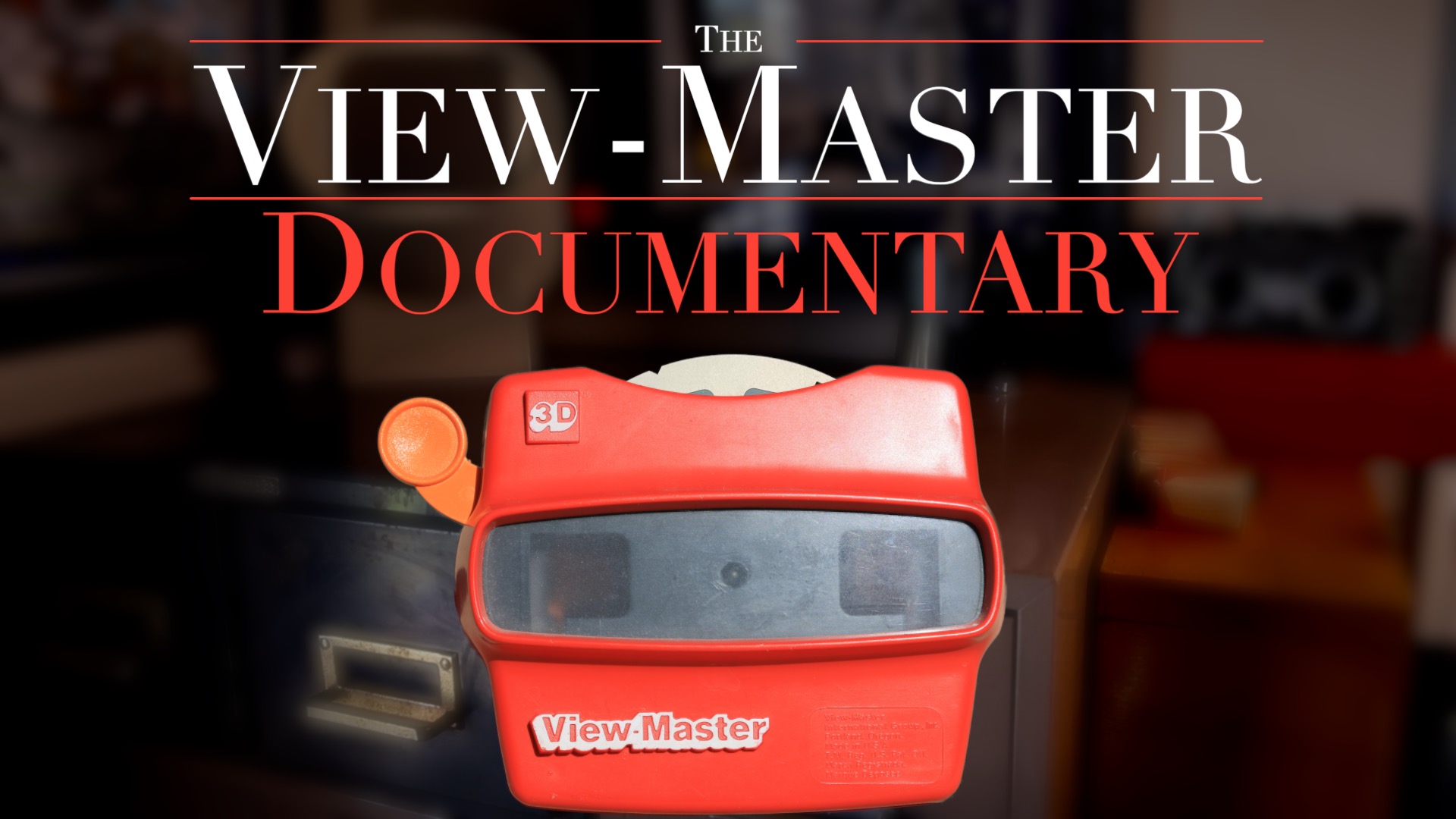
I spent nine months independently writing, narrating, animating, and editing this documentary to tell the complete, untold story of View-Master.
Along the way, I interviewed original experts, dug up forgotten FBI files and SEC records, and reconstructed the actual physical techniques used to build these 3D reels.
If you want an honest, deep-dive breakdown of the brilliant people and chaotic corporate drama behind the viewer, this video is for you.
Made in collaboration with Peter Dibble, who helped with a lot of the research. He makes long-form documentaries on obscure history from the Pacific Northwest and beyond. Definitely check him out: Peter Dibble on YouTube.
Thanks to Mary Ann and Wolfgang Sell for their contributions to View-Master collecting over many, many years. Their book View-Master Memories was a significant resource to this video.
Very special thanks to Gretchen Gruber for her interview and her book View Master - The Biography of William B. Gruber.
Extra thanks to John Kurtz for several phone conversations, including the one in this documentary. I could only include a little bit of our conversation — it was all super interesting. John's current work is available at the Animazing Gallery in Las Vegas: Animazing Gallery.
Thanks to Rich Dubnow for taking the time to talk with me — and your help confirming (or denying, as the case might be) some of my assumptions. If you need your own View-Master reel produced, visit Image3D.
Thanks to Keita Wangari for your fantastic photographs of 3D viewing devices over the years. Your collection is first rate and organized very well at Vintage Viewers.
Narration of Gruber's diary by Time Winters — find him at Time Winters.
Additional audio production by Simon Machin — check out his other work at The Black Veil Audio.
Several pictures related to Stereocraft, from Susan Pinsky and the 3D Legends Hall of Fame — lots of great information here: 3D Legends Hall of Fame.
Many quotes and images from back issues of StereoWorld magazine — available at: StereoWorld.
Image of Deutsches Museum in Munich by Burkhard Mücke.
Image of Brian May using the Wheatstone Viewer is from Kings College London.
Recording of Welte Mignon and much information about them from The Pianola Institute.
The footage from Madison Square Garden was taken from the film A Night at the Garden by Marshall Curry.
Footage from the 1939 New York World's Fair is from a Westinghouse promotional film.
Black and white View-Master plant footage and interview footage from an episode on Sawyers from Success Story, a 1950s TV documentary series by the Richfield Oil Corporation.
Interview with Florence Thomas from Home with Arlene Francis, 1955.
Images used for William Gruber's experiences in Germany are period correct, but are not necessarily depicting exactly what he's saying. They also don't show Gruber himself.
Picture of the Kodak and GAF Photo Trail at Disneyland was from DaveLandWeb.com.
Bottle of Trilene is Creative Commons, the Wellcome Trust, a global charitable foundation from the UK.
Stereo Realist slide of a building by John Alan Elson.
Stereo Realist camera by Kim Scarborough.
Video clip of a Rols Dictation machine taken from @GrumpyTim.
Video clip of Rols recording material from the Oregon State Archives.
Music and some sound effects from Epidemic Sound.
Other sound effects used:
The image of women assembling “model B” viewers has been colorized. The letter from the FBI to William Gruber is quoted from the FBI file, but the letter is generated since there is no image of it.
AI images include the image of the FBI interview room, the images with television sets in them (although what's on the TV was added by me), a background image of a drive-in, and some other minor image assets.
The initial gunfighter “coming alive” was AI generated. Restored color of View-Master images was AI.